The Story of Hester's Canvey Island Developments
Holidays at Canvey-on-Sea
The Story of one of Canvey’s best known developers, Frederick Hester
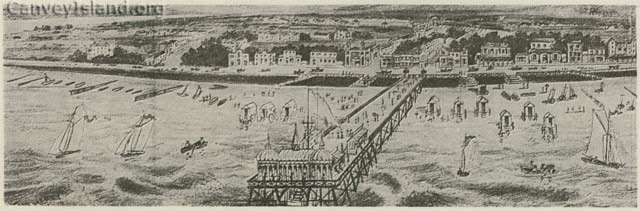
The Sea Front & Jetty taken from Augustus A. Daly’s ‘A History of Canvey Island’
At the end of the 19th century an entrepreneur had a dream of turning Canvey into an Island holiday resort. Frederick Hester was born in Fulham in 1853, the son of George Hester (reputed to be the last keeper of Putney Bridge) and Catherine (nee Potter) who had six children together.
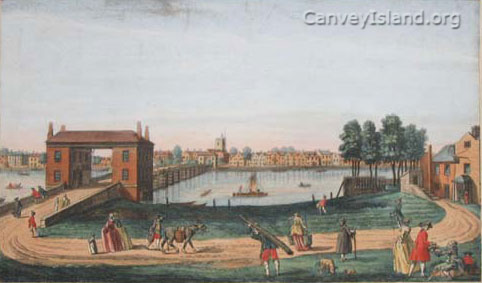
Old Putney bridge including the Bridge Keepers House
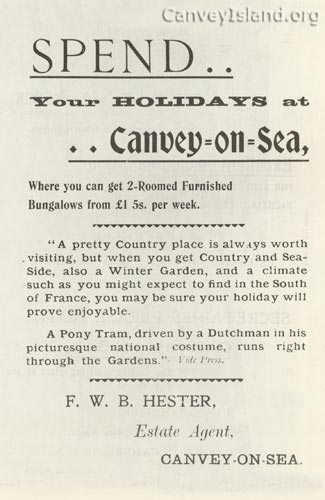
Frederick married Sibyl (nee Brewster) and they had seven children together, some of which were to help their father in his Canvey project. The Poster shown in the Gallery at the bottom of this page is typical of what would be seen around London also as flyers in the late 1890’s, advertising their Canvey Island development.
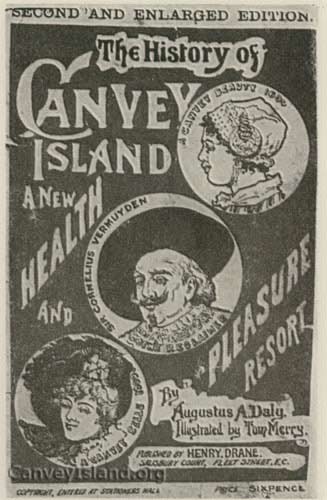
Augustus A. Daly’s promotional book ‘A History of Canvey Island’
“F.W.B. Hester” in the poster was Frederick’s estate agent son, Frederick William Brewster Hester who was born in 1876 and named after his Mother & Father. He was to play a big part in his Father’s project and remained on Canvey all his life.
With the expansion of the LT&SR railway line from Fenchurch Street to Southend-on-Sea, Frederick took advantage of the close proximity of Benfleet Station to the adjacent reclaimed Island that was potentially an ideal holiday resort for Londoners to get out of the smog and taste some good wholesome salt air and ozone!
A small book (See right) was commisioned by Frederick Hester and published in 1902 called ‘A History of Canvey Island’ by A.A.Daly.
* * *
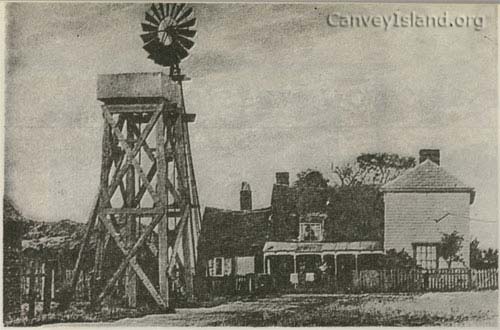
Leigh Beck Farm on Canvey Island
Promoting its Dutch history the book read more like a promotional guide to what glorious plans Frederick had for the Island than a history book. It featured many illustrations by a local artist Tom Merry.
The Illustration at the top of this page is Tom Merry’s impression of Canvey sea front (Shell Beach) Promenade with the Pier. Later photos will show the early development wasn’t as grand as this!
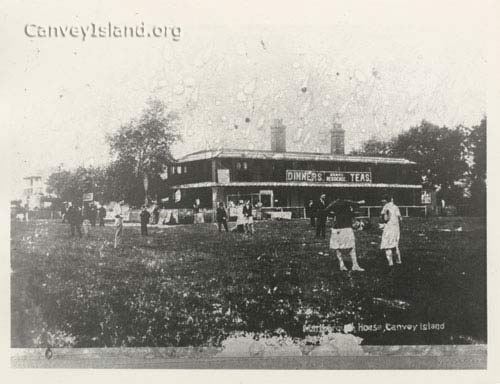
Marlborough House – Station Road, Canvey Island – Picture thanks to Eileen Jackson
From 1897 Frederick started to buy land on Canvey including Leigh Beck Farm where it is understood he lived for a while. An artisan well was sunk that supplied fresh water by the bucket that could be purchased for 2 pence a pail. Along with other land he owned, it was divided up into small plots to be sold to the London visitors encouraged by the posters offering a free train ride and lunch! Along with other members of his family, Frederick went into partnership with Mr Hillman who loyally stayed by him over the next 7 years.
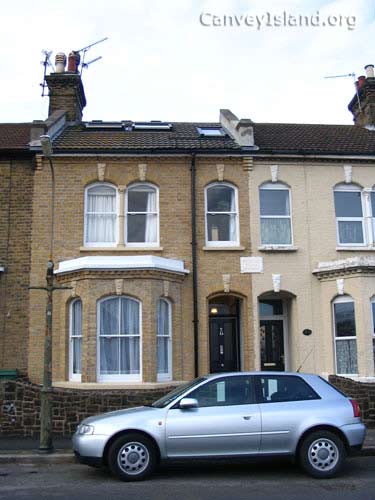
25 Stanley Road in Southend-on-Sea in 2007
The 1901 census shows his son FWB Hester living with his wife Elizabeth and their son in ‘Sea View Leigh Beck’. In 1964 one of Fred’s son’s Herbert Frank Hester explained that during these early days he had lived with his brother FWB in ‘Leigh Beck House’ and that their father Frederick lived in Marlborough House (see above).
He stated that Marlborough House was in fact the first house his father built on Canvey and that it was later bought (possibly in 1904) by Mr Harding who converted it into a guest house. A document dated June 8th 1904 in which Frederick Snr is applying for permission to build a Railway Generation House (See later) gives his address as Marlborough House at that time.
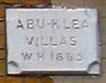
Close up – Built in 1885
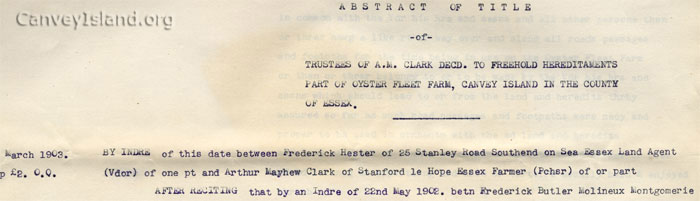
Other records at the time like the Oyster Fleet Farm document seen in the Gallery at the bottom of this page show Frederick had a house nearby at Stanley Road in Southend-on-Sea (March 1903). The 1901 census shows Fred lived at this address with his wife Sibyl and children. Adjacent is a photograph I took in 2007 showing the house still stands. At the time of the Hester occupation it would have had a clear view of Southend Pier and the trams running nearby – inspiration perhaps for his plans for Canvey!
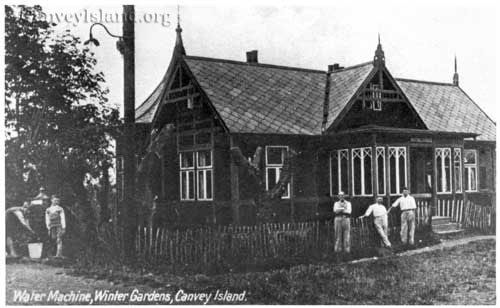
The Swedish bungalow at Wintergardens
Going back to the account Herbert Frank Hester gave in 1964, after Fred sold Marlborough House he bought a six bedroom bungalow from Sweden that was erected by Swiss tradesmen (perhaps this is why there is confusion over its name on different pictures!) H. Frank explained they lived there for five years until it was sold in a deal along with the adjacent Winter Gardens complex (as a going greenhouse concern) to Major Addison for £8,000. This must have been at the time of bankruptcy in 1905. The Swedish bungalow stood on the corner of the present day Station Approach & Lekoe Road. It is shown on a 1923 plot map but I can only remember as a child in the 1960’s the land it occupied was overgrown with strange man-made shaped rocks covered in sea shells. It was only recently the mystery of this piece of land came to my knowledge! Nearby a covered tap stood by the (old) sea wall (Central Wall – Winter Gardens path) which must have been a remnant of the Pump shown in the picture of the Swedish bungalow above.
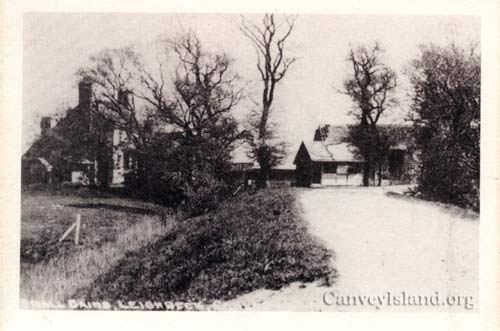
Smallgains Corner & Farm
H. Frank explained that after the Swedish bungalow was sold they lived in Smallgains Farm (pictured left) for another three years. As far as I can gather Fred’s son FWB was to spend the rest of his life here until an unfortunate accident in 1911 where he died of Tetanus caused by cutting his thumb whilst using a bread cutting machine. I understand he is at rest in St Katherines churchyard on Canvey.
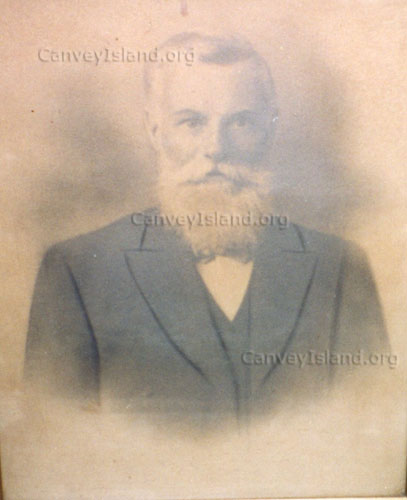
Frederick Hester – Photo (c) by permission of Veronica & John Overland
Frederick Hester’s short time on Canvey Island is a fascinating and sometimes mysterious part of Canvey’s history due to the small amount of information available about his developments. Whilst much is documented about his plans it is more difficult to find out how much was actually built. By all accounts he was a tall powerfully built man with a commanding voice and distinguished appearance.
To the left is a photograph of this great man which was produced for the first time on CanveyIsland.org.uk in 2007 with kind permission from his descendants.
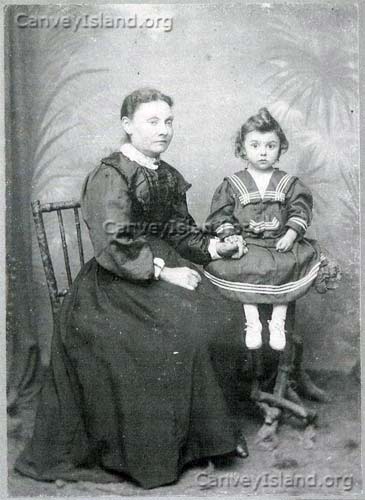
Photo (c) by permission of Len Maylin
* * *
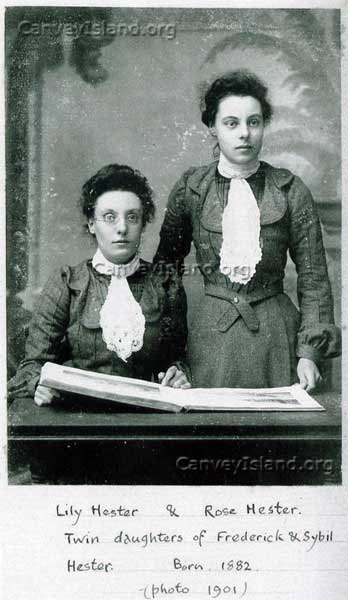
The next photos were first made available by Len Maylin for CanveyIsland.org.uk, and showed for the first time some of Frederick’s family. The first is of his wife Sibyl (nee Brewster) with their grandson Victor. The second, a photo of Frederick’s twin daughters Lily and Rose, is at the base of this page in the Gallery. This was taken at the time of Hester’s development on Canvey Island.
* * *
Thanks to Paul Chetwin for his help in obtaining these photos and Len Maylin for kindly giving permission.
* * *
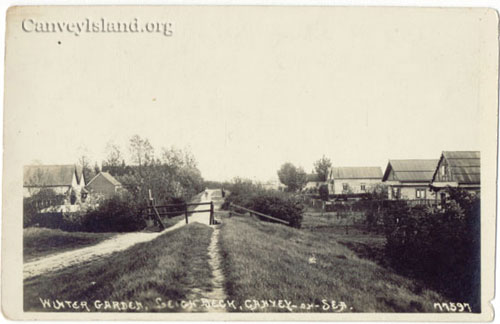
Temple Bar – Hester’s Swiss bungalow can be seen behind the trees on the left
Around 1902 Frederick started to develop his very own £10,000 version of the Crystal Palace called “The Vermuyden Summer & Winter Gardens“. It became known just as the Winter Gardens and consisted of about 2 miles (6 miles was planned) of attractions including botanical gardens housed in greenhouses running south to the lake from behind the properties on the right of the picture (right). You can also see Frederick’s Swiss bungalow behind what could be the Mono Rail ticket office (left).
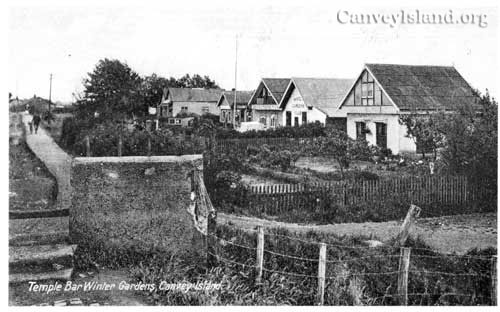
Temple Bar – Wintergardens – The path shown is now Station Approach
The next picture on the right is a much later photo of the same area. The wooden cattle grid has been replaced by a concrete wall with metal spikes. This is known as “Temple Bar” after the more extravagant version in London! The right hand part of the wall was demolished in the 1980’s but the left part stands to this day without the spikes which I believe were removed by the Council on Health & Safety grounds.
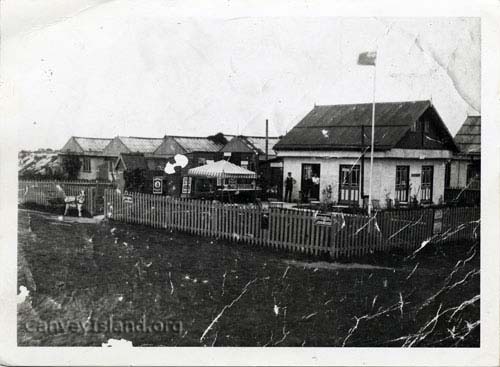
Winter Gardens – Picture thanks to Eileen Jackson
The property (above right) with the flag pole in front is Powell’s Stores (Corner House / Lunns) but years earlier it stood alone as can be seen in the rare photo (right). Here we are standing on Central Wall with an unmade Central Avenue going left. The date is unknown but many greenhouses can be seen spreading south. I am convinced we are looking at Hester’s Winter Gardens.
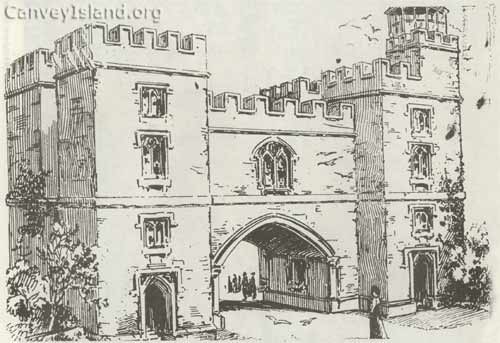
How Tom Merry imagined the Tower in 1902
Examination of the photo above reveals a goat cart at the side gate. What looks like a snow covered Sea wall on the far left I believe is in fact the man made continuation of the Winter Gardens, as it clearly isn’t winter and there was no sea wall here!
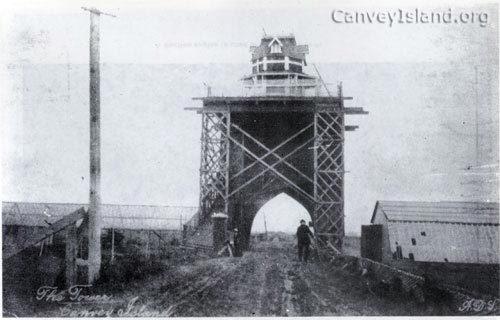
Temple Bar – Wintergardens – The path shown is now Station Approach
A.A.Daly’s book ‘A History of Canvey Island’ shows an idealised Castle type structure as the entrance to the Winter Gardens (above left) but the photo left is the only known picture of the actual 50ft Tower, probably from the rear. The entrance to Winter Gardens housed ‘Poets Corner’ filled with statues & busts (see later) and apparently had a carbite light on top illuminating the area by night. I have spent some time trying to find out exactly where this tower was by close examination of pictures of this area. In the Photo left we appear to be standing on the old Sea Wall (Central Wall) – note the steps left. There appears to be a Post ‘Pillar’ Box by the tower steps – other photos reveal a similar structure at the front of Lunns Store (see later). In the distance the path rises and to the LEFT we have greenhouses. The final clue was the fence to the right….. compare it with the next photo of Hester’s Swiss bungalow.
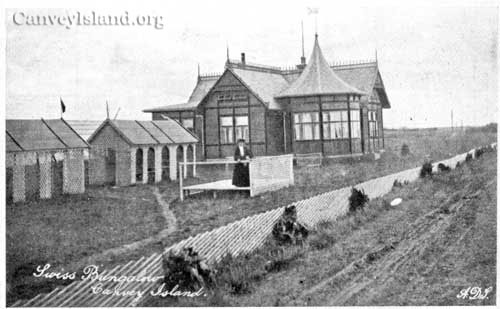
Looking east at Hester’s Swiss bungalow from Central Wall, with that same fence
Popular local opinion is that it is Frederick Hester walking under the Tower in the Tower photo which appears to have been opposite the Powell’s Stores building and the greenhouse shown would have been the entrance to travel south between Central Avenue and Church Parade. We would be looking west at the back of the Tower and Temple Bar would be in the distance. Does a photo exist of the front? Frederick used the Tower to allow prospective customers to view the land plots he had for sale from its octagonal ‘show bungalow’. Apparently the Tower stood until it was discovered it was unsafe due to timbers being removed by locals for use elsewhere! It was demolished in 1909 and the ‘show bungalow’ was removed from the top and sold to a man in London for a garden summer house (does any one know where?)
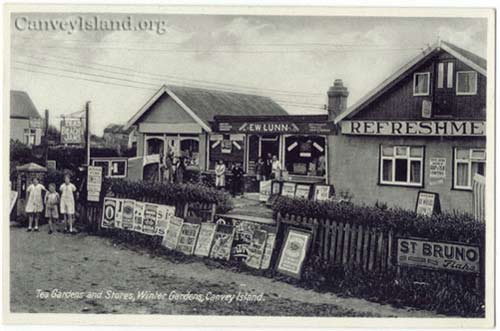
The (same?) Post Box far left outside Lunns Store
The photo left shows the same Winter Gardens building (far right) that was later extended up to Central Avenue and housed Powells / Corner House / Lunns Stores. The children are standing next to a Post Box that I believe could be the same one shown at the entrance to the Tower. I remember Lunns Stores as a child but it was demolished around the 1980’s. Houses now stand here but a new Post Office is just round the corner. Behind the building in the early 1900’s the Winter Gardens ran for two miles featuring electric light even before Canvey had mains electricity. In heated green houses rivalling Kew Gardens you had fish ponds, fountains, bazaars, grottos, exotic plants, cafes, restaurants manned by ‘Dutch’ waiters and a Poet’s Corner featuring busts and statues. It is said Hester’s Winter Gardens sold produce to Covent garden.
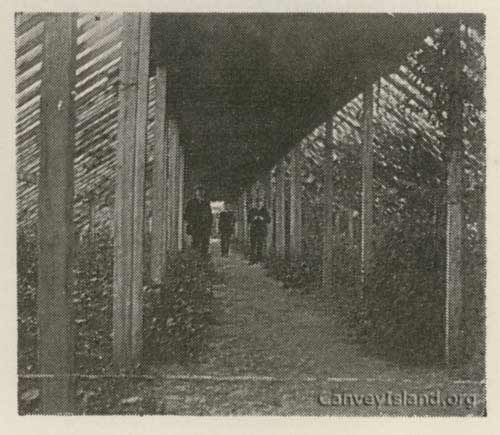
This rare Winter Gardens photo from c1908 was taken by H.G.Axtell
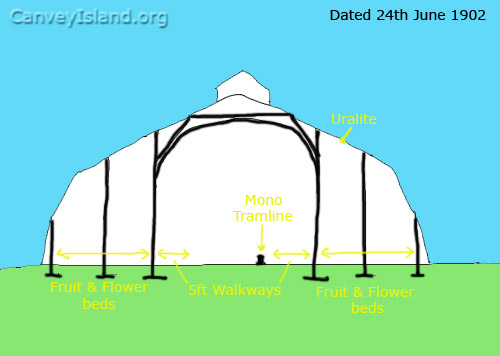
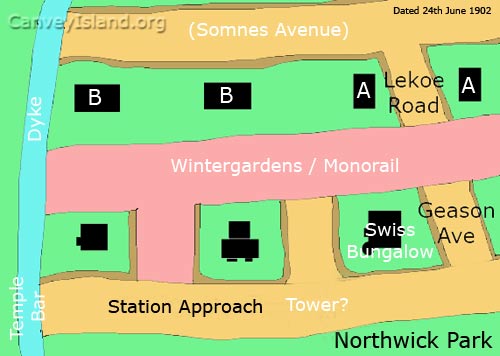
In the Gallery at the foot of this page I have made these partial sketches from the large original 24th June 1902 plans available in the Essex Record Office (D/RR/5/2/5). I have added the white wording but the black lettering and the white “A” & “B” letters is as seen. I don’t know what the “A” & “B” is referring to but these buildings went all along either side of the Wintergardens so I guess it is two different styles of house or bungalow. Hester’s Swiss bungalow is instantly recognisable from its shape. Lekoe Road exists to this day and now incorporates Geason Ave. Station Approach also still exists. You can see the Wintergardens (Pink) was to cross Station Approach which incorporated the Sea Wall / Wintergadens Path. From the ‘Tower’ Photo seen previously, the Greenhouse would have met here on the South side.
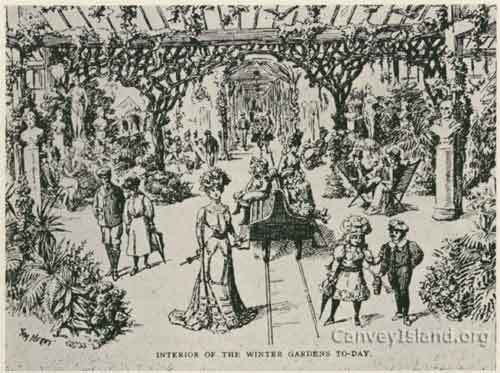
Interior of the Winter Gardens – Tom Merry 1902
The plans also include the layout of the Wintergardens as sketched below in the Gallery. I am now convinced the original idea would have been not only to have had the glass covered rail running south parallel between Church Parade & Central Avenue but Hester planned to cover the whole track along Somnes Avenue eventually reaching the Shell Beach! Later when electrification was set underway with a dual track and Trams, perhaps this plan was dropped?
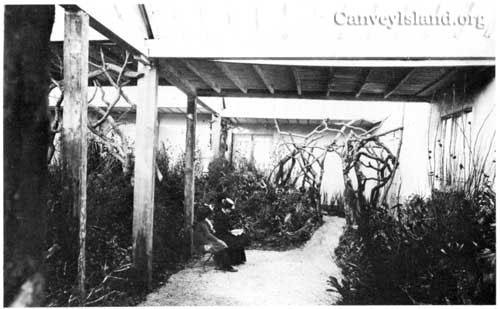
1902 Postcard of the interior of the Wintergardens
* * *
The picture above right is from A.A.Daly’s ‘A History of Canvey Island’ and shows an artists impression of inside the Winter Gardens with a indoor bench seat railway track ferrying people through the complex.
* * *
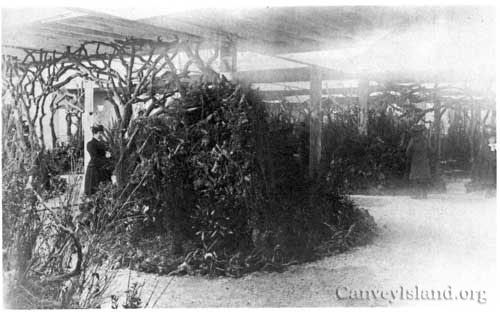
1902 Postcard of the Botanical gardens in the Wintergardens
In 1964 Miss A.W.Currie recounted her memories of the Winter Gardens. In 1906 her parents bought a roomy bungalow at the Wintergardens for £200. She said the area still contained a large amount of glass, empty animal cages and an abundance of oriental shrubs & trees.
* * *
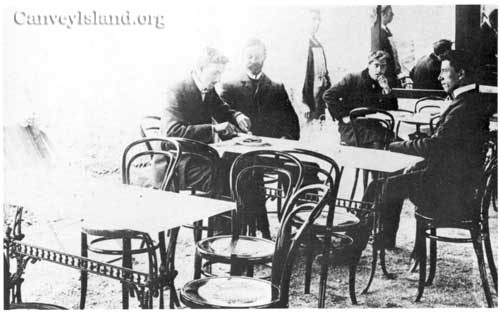
1903 Postcard of the Tea Rooms in the Winter Gardens
Miss Currie also said the narrow gauge railway shown still ran behind their garden and the children used to ride along through the long grass on a remaining bogey!
* * *
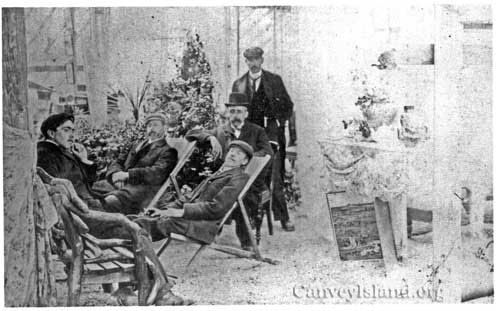
Inside the Wintergardens
Here are another two photographs of the interior of Hester’s Winter Gardens. As there doesn’t appear to be any photographs taken from outside we could conclude that all the beauty was inside and the exterior was probably plain greenhouses as shown in the ‘Goat Cart’ photograph… please prove me wrong!
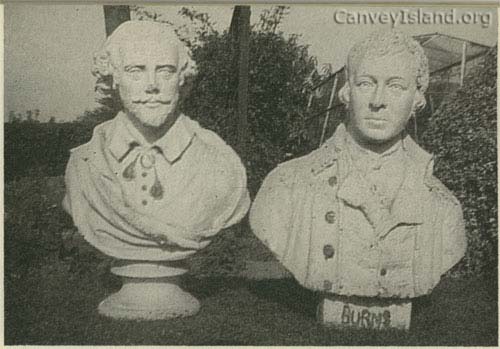
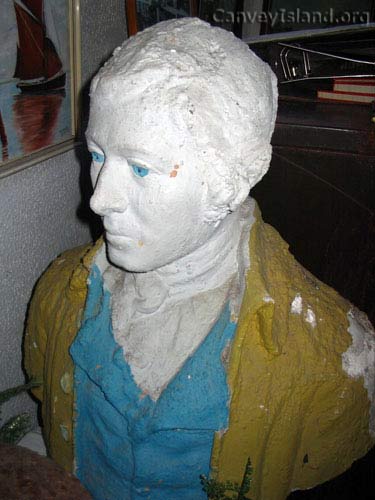
Two Busts reportedly from Poets Corner in Wintergardens
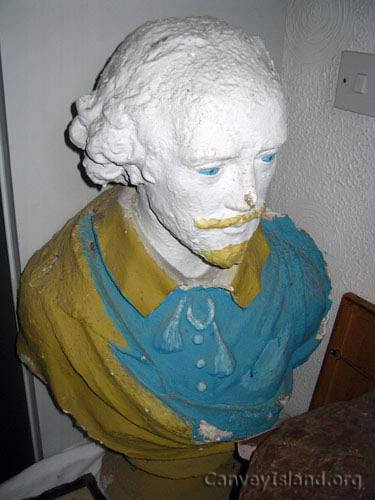
In 1968 Mary Crane wrote that she had two busts in her ‘Bernside’ Odessa Road garden that were from ‘Poets Corner’. I understand Poets corner was at the entrance of the Winter Gardens complex. The busts were of Shakespeare and Burns with “A.L.Vagoss 1885” marked on the back.
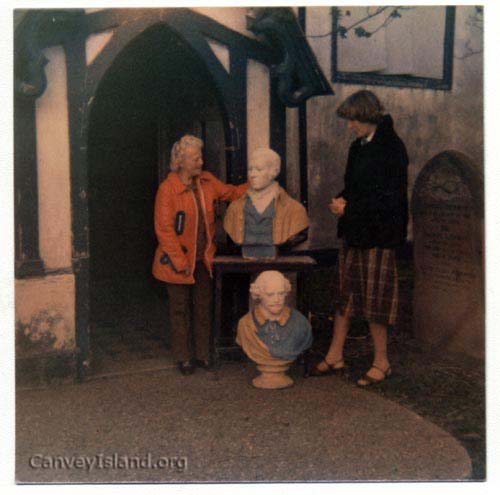
Outside Saint Katherines Church where the Busts are currently stored
The busts were later donated to Aubry Stevens of the Canvey Historical Society. Thanks to his son Graham for donating the photo left that shows them being displayed outside St Katherines Church with a younger Margaret Payne on the right. Does anyone recognise the lady on the left or know who painted the busts?
The two busts are now stored in St Katherines Church. To see close up Photos taken in May 2007 look in the Gallery at the foot of this page.
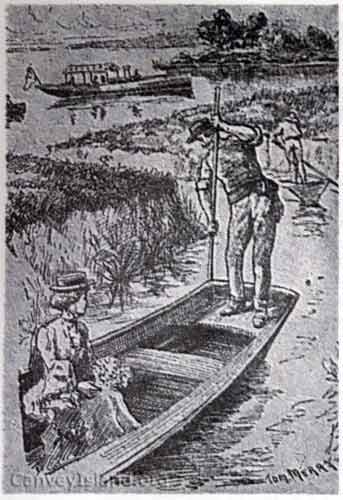
Canvey – ‘Little Venice’ Tom Merry illustration from 1902
Other planned Hester attractions were electric Launches, illuminated Gondoliers & Punts in the creeks and on the Knightswick Farm Lake – Hester’s very own ‘Little Venice’!
* * *
The land lost at Canvey Point after the 1881 flood was ear marked for a luxury Marina with a floating restaurant and houseboats. At Leigh Beck a gambling Casino was built by a syndicate thinking the Canvey’s reclaimed land was out of British jurisdiction!
* * *
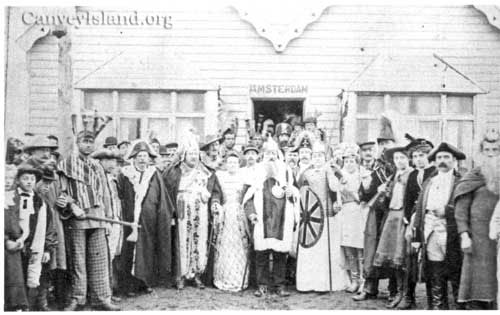
1902 – King of Canvey Carnival. Where was this Bungalow?
Here (right) is a 1902 scene from a ‘King of Canvey’ festival in the Winter Gardens area. The three day carnival would include ‘Canvey Aborigines’ (yes even then!), fireworks and a Guy Fawkes bonfire. Col & Mrs E.Clarke were crowned the King & Queen of Canvey with the members of the public and the Benfleet Highlanders Band meeting them on a “Royal” barge.
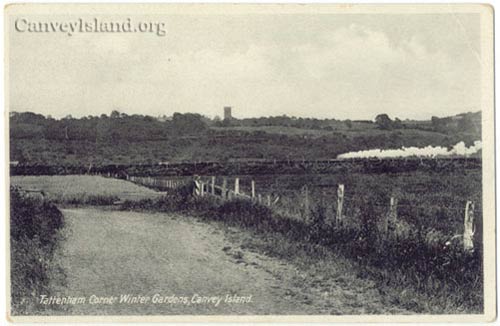
Named after a Race horse, Tattenham Corner remains to this day
After enticing people from London to South Benfleet railway station, Frederick had to transport them from the Ferry to his nearby Winter Gardens complex to buy land from £5 a plot. You could walk along the old sea wall which today is Wintergardens Path (right) – now through a golf course, or why not take a ride on a brand new invention – the Metal Mono Rail!
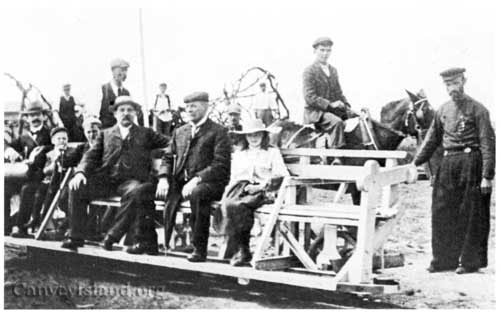
Postcard of Hester’s Horse Drawn Mono Rail
In 1904 a single track caillet-type “mono-metal tramway” was laid. I’m not sure if it ran from Canvey Ferry to the Wintergardens but it did run from the Wintergardens to at least where the Admiral Jelicoe now stands and possibly as far as Shell Beach on the south of the Island. People have memories of the driver being dressed in Dutch uniform to emphasise the Dutch history of the Island.
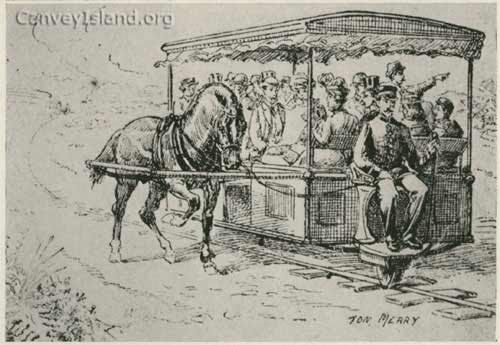
Artists Tom Merry’s 1902 impression of Hester’s Horse drawn Mono Rail
The railway occupied a strip of land 30-40ft wide which can still be found marked on many old building deeds. The plans had been drawn up in 1903 by Mansfield Owen & Co of Westminster. Again from A.A.Daly ‘A History of Canvey Island’ the picture (right) shows a drawing of a wonderful contraption, in reality it was a little more plain.
* * *
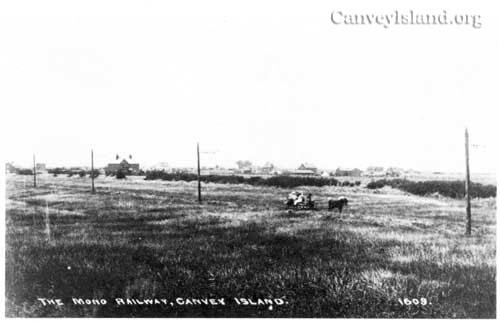
The Horse Drawn Mono Rail (Somnes Ave)
Next is an interesting photograph of the horse drawn mono rail. We are looking south east from where Somnes Avenue now runs. The grass bank in the background would be Central Wall – The Winter Gardens path and I believe the large house is Kingsley Hall that stood near the west end of Mornington Road. The two big trees in the centre of the photo are probably the two that straddled Furtherwick Road where the Job Centre now stands.
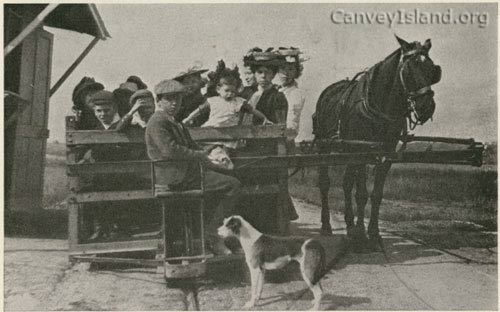
Postcard of Hester’s Horse Drawn Mono Rail
The really interesting thing about this photo is the fact that there are electrification poles in situ!
The next photo (right) is another shot of the mono rail standing next to the ticket office.
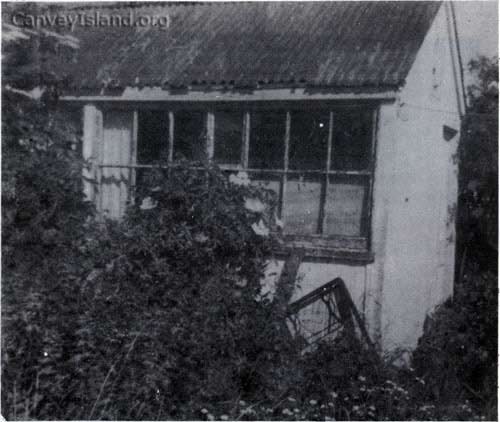
Mono Rail Ticket Office
The Photo (right) that was taken by Fred McCave in the late 1970’s is reported to be the Ticket Office, probably on the north side of Temple Bar. It was demolished soon after.
R.S.Morgan wrote of early memories of riding for three miles through ‘fields of waving corn’ before arriving at Leigh Beck, very near to Marlborough House. Apparently there were passing places and the odd derailment wasn’t unknown!
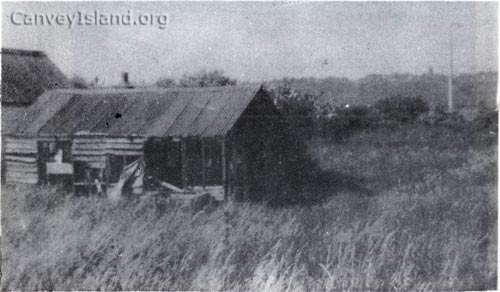
The Stables for the horse drawn Mono Rail
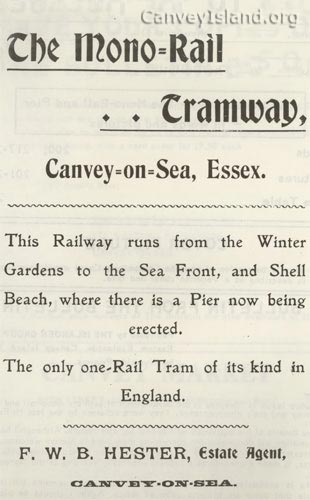
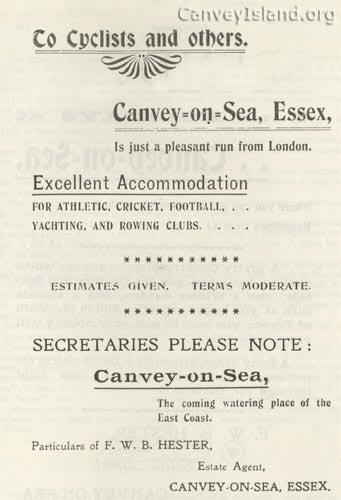
The next Photo (left) was also taken by Fred McCave in the late 1970’s and is reported to be the Stables for the Mono Rail horses. The pole in the background is probably Somnes Avenue so this would be on the north side of Central Wall road near Temple Bar. Needless to say it has long been demolished. In the Gallery below is an advertisment from the A.A.Daly book for the Mono-Rail Tramway.
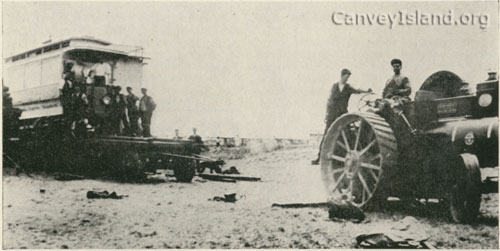
Delivery of the New Tram Cars in 1904 at Benfleet Station (TMS Photographic Service)
The engine shed was erected at the junction of Dovercliff Road & Westcliff Gardens and access to the terminus was via a clinker path along Station Road that Frederick had laid. A bank along the west boundry of Leigh Beck school apparently is evidence of the route. The photo (left) shows one of the trams being delivered in 1904. There is another Photo of another one on a horse drawn cart.
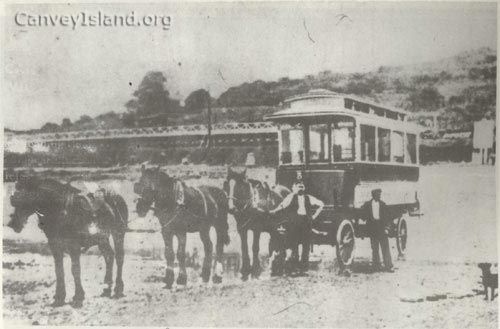
Another 1904 picture of one of the electric trams being delivered accross Benfleet Creek by cart
Four 24 seat electric Trams were bought and delivered to Canvey in 1904 and one was later found to be marked ‘Canvey Island Electric Tramways’. They were enamelled red with gold lines bearing the livery ‘Venice on Sea and Canvey’. Due to problems landing the large 30 foot (3ft 6in gauge) rails and a certain property owner not allowing access to his land (no details to date) Peebles had to be compensated £1,000 for the delays and more cost was added by overtime inc Sunday work. They had been originally contracted to complete by 1st July 1904 but the plans had only reached the council in June. Only a 4878 metre section of the new rail was laid between Winter Gardens and the Lakeside corner area before the contractors started removing materials.
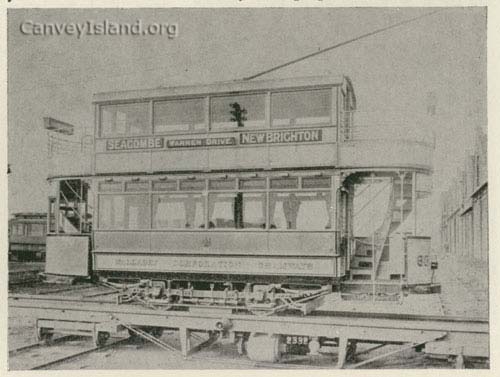
Look to the left behind the Trolley Bus
On 7/4/1905 an auction was held at Chimney’s Farm & all the seized rail materials including 1,000 of the 4,000 sleepers were sold. The new Trams were returned to Brush, two sold on to the Llandudno & Colwyn Bay electric railway in 1907 and the others cannibalised, one eventually becoming a cricket pavillion (where?). The 1915 photo (right) of the Brush works in Loughborough shows one of Hester’s actual Trams stored in the background on the left.
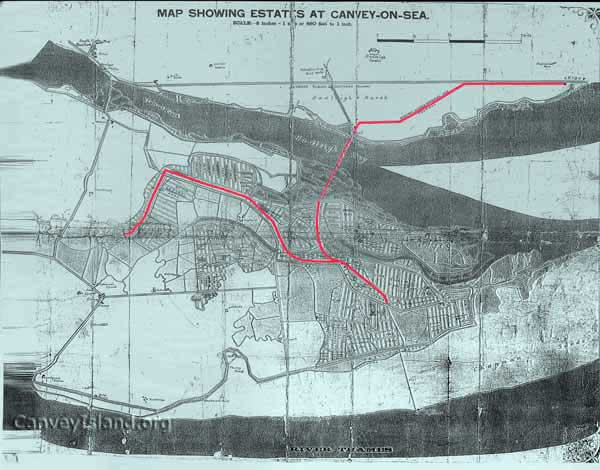
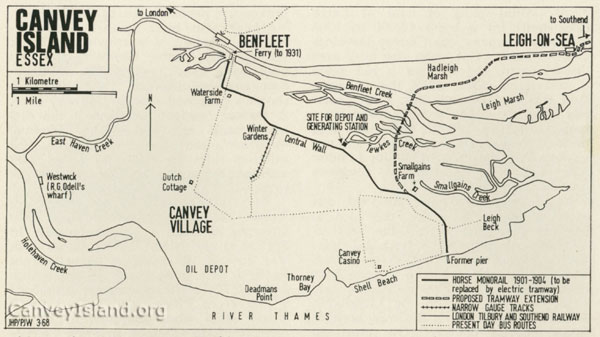
The 1902 map in the Gallery at the bottom of this page that recently came to light is an early development plan for Canvey showing roads and estates named by Frederick Hester (i.e. Kloster Park etc). More interestingly for this section is the planned electrification and expansion of the Mono Rail. Far left on the map we see the (north south) narrow gauge route through the Winter Gardens and from left to right we see the other existing route from the Winter Gardens, parallel to Central Wall road & north of the High Street, round Smallgains corner alongside Westerland Ave and possibly crossing the High Street to the Sea Front along side Seaview Road (not shown here). The plan was to meet up with his Pier (See later). A third route was also planned (centre – north south) from Smallgains to Leigh Station by extending the Salvation Army Jetty at Hadleigh (see the colour photo below taken in 2006).
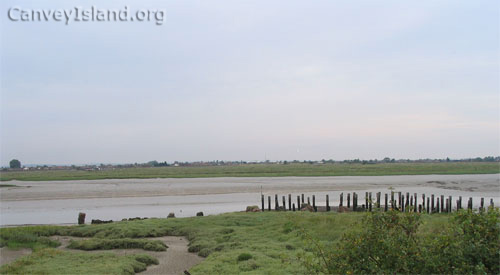
Looking South over to Canvey with the derelict Salvation Army Jetty
The second map in the Gallery at the base of this page shows the full nature of Frederick Hester’s railway plans including the rail going onto his Pier. Bruce Peebles & Co Ltd of Edinburgh had the £14,500 contract and by August 1904 4km of rails had been laid on 4,000 creosoted sleepers. Another £34,000 of work got underway including car sheds and a generating station at Tewkes Creek, the plan being coal could be delivered by Barge. A recent examination of this area sadly revealed no remaining evidence of its presence, unfortunately the substantial foundations were blown up during World War 2 in case invading Germans used them for a gun placement!
Canvey lost its chance of having its own public tramway and all evidence of its existence has long gone, the tramway land being divided up and sold in 1918. In the sixties it was reported some of the 100ft apart pole concrete bases could be seen along Somnes Ave and one was being used to as a bird bath. A few parts of rail are hotly contested as remains, Fred McCave had a piece in his Riverside Cafe museum (what happened to this?) and there is currently a piece at the Dutch Cottage Museum.
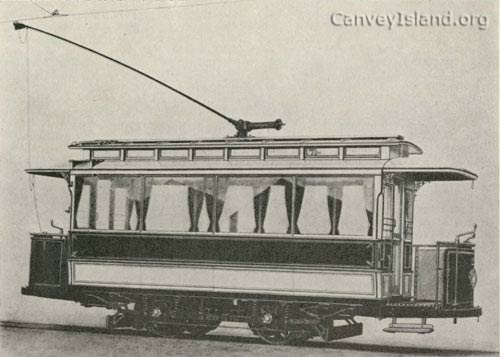
The type of Tram purchased by Frederick Hester for Canvey
There’s also a rumour of some iron work including a railway turntable being dug up during development in the area and apparently a piece of the rail was used as a bridge across a dyke in Knightwick fields in the 1930’s.
Another account of the rail scheme can be found in “Tramway & Railway World” for March & April 1904 but unfortunately I don’t have access to a copy.
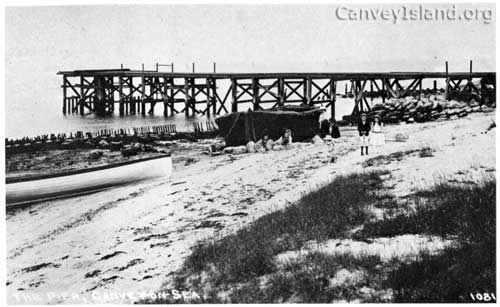
The Pier at Shell Beach
Frederick Hester dreamed to rival Southend-on-Sea by building a two and a half kilometer two-storey Pier which he planned would reach the Chapman Lighthouse. To the left is a photograph of some of what he achieved. I have examined the full plans of his Pier in the Essex Record Office.
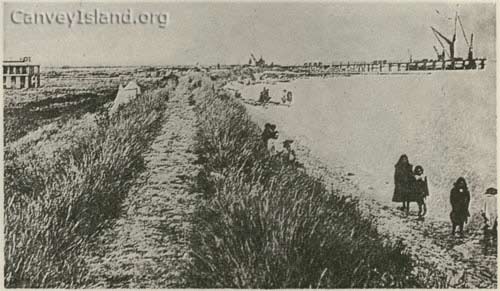
Loading at the Jetty / Pier
This Photo (left) shows his pier with a Thames Barge unloading materials onto a small locomotive that ferried the materials to shore – Frederick certainly planned on joining the Pier with his railway that ended in this area. Marlboro’ House, the first building the Hester’s built on Canvey, can be seen on the far left.
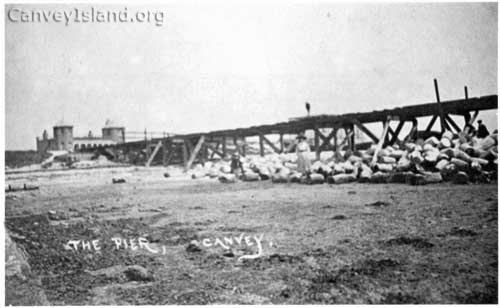
Postcard of The Pier inc Concrete Barrells
Left is another photo of Hester’s Pier with the Beach House Hotel behind the sea wall. A man appears to be standing on a structure behind the Pier. The white barrels shown in the foreground are concrete and are from the Ben Mohr (See later).
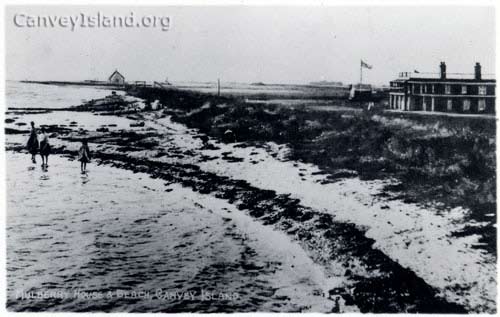
View form the Pier inc Marlbough House
Frederick’s Pier was opposite the now Westcliff Gardens. Only 122 metres were built and it was later dismantled and replaced by the Chapman Yacht Club Jetty. Remains can still be seen at low tide. The Photo (left) was probably taken from Frederick’s Pier and shows his former residence Marlborough House on the right.
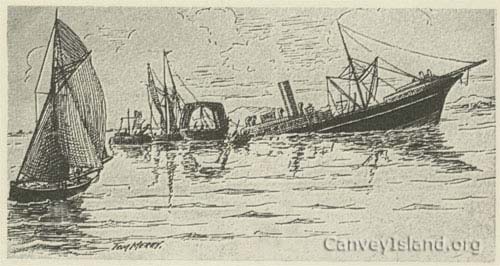
The grounding of the Ben Mohr 1902
In 1902 the SS Ben Mohr collided with the SS Banffshire in deep fog and was grounded off Canvey at Dead Mans Bay to prevent her sinking. Her cargo included Portland cement in wooden barrels. The cargo washed up along the coast and the cement solidified in the barrels. Apparently Frederick Hester bought the cargo and used many of the barrels as foundations to his Pier (shown above).
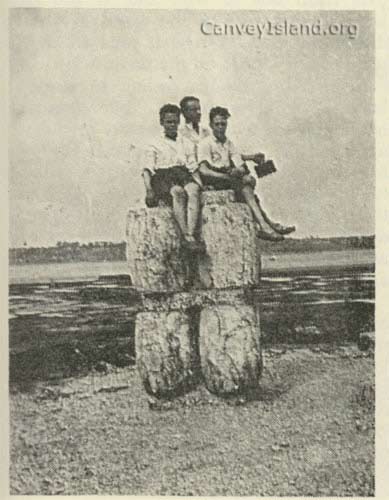
Concrete Barrels
Even today remnants of these barrels can be found and they have been used as building materials all over the Island. This year we went looking and to our joy discovered a barrel!
The end of a dream
Due to Canvey’s habit of flooding, in 1904 much of the plot land that Frederick was trying to sell was temporarily under water with the spring tides and he had understandable difficulty with customers! Frederick Hester’s Canvey enterprise went bankrupt and after staying on to settle up his affairs he moved to Burnham-on-Crouch where he remarried to Alice Clarke. They had four children together and he carried on redeveloping, this time ‘the Pits’ at Burnham-on-Crouch where he has ‘Hester Place’ named after him. Frederick lived to a ripe old age of 81 and died in 1934. I believe his widow Alice went on to run a guest house for billeted soldiers during the war.
I have only touched the surface here and plan more research, the story of Frederick Hester is also covered in print by authors such as Robert Hallmann (Canvey Island – A History) and Geoff Barsby (Various). I would like to give special thanks to Paul Chetwin for his extensive help with the Hester family tree as well as Janet Penn & Margaret Payne. Thanks again to John & Veronica Overland for the Frederick Hester photograph. Other publications used for research included Steve Bullock’s large collection of ‘Essex Countryside’ magazines, Fred McCave’s Bulletins (esp June 1984), ‘Modern Tramway’ (Vol 31 No.365 May 1968), ‘The Tramways of East Anglia’ by Anderson & Gillham (LRTA), The Railway Magazine (No.170, Aug 1911) and D.M.Dowd’s ‘Canvey Cylopaedia’ (with thanks to Jan Penn as it’s unpublished).
Cllr Joan Liddiard, Robert Hallmann, Margaret Payne, myself and others are encouraging the placing of a memorial plaque erected to Frederick Hester on Canvey in the future, hopefully at the Wintergardens site named after his venture there. A great man who deserves to be remembered on Canvey Island by generations to come. For info join us on the Canvey.org Forum.
Story originally published on CanveyIsland.org.uk by David Bullock on 18th March 2007 : This latest revision: 20th April 2008
If you can add or correct any information please leave a message below or email in.


Comments about this page
The Swiss House – My family moved to the Winter Gardens in 1949 and it was called ‘Scott Holland House‘ and was rented out over a long period by various people. Mr & Mrs. Haggis who built several bungalows down Concord Road also lived there for a time. One family came over from India about 1953 and the twin daughters were appearing in ‘The King and I’ in London. I have a photo of the Coronation Party held in the Winter Gardens showing the twins and their older sister. The mention of the Water Tap outside ‘Scott Holland House’ just off the Path was used by us to get fresh water. We paid a £1 per year to the council (I think) for a key.
My Grandmother, Nelly Childs, first visited Canvey Island before the First World War. I remember asking her about the Winter Gardens, She said they never existed and were just advertising puff and pipe dreams of what might have been. As she walked along the Winter Gardens footpath scores of times she could hardly have failed to have noticed them if they had existed. Also there is no evidence of them on any Ordnance Survey maps of the time.
I seem to remember in the late 1960`s when I was a member of the 2nd Canvey Island Cubs and Scout movement, that our scout leader Mr Bishop and later Tony Peck lived at Oysterfleet Farm, halfway down Denham rd. They alledgedly had pigs at the farm but unfortunately I never saw them (the pigs I mean).
I remember ‘Scott Holland’ house and visited it often to see my friends who lived there in the early 50’s. They were from India and there name was Mr and Mrs Long and their 4 children…Valerie the eldest daughter, twins Joyce and Daphne (who played 2 of the children in ‘The King and I’ in Drury Lane) and their only son was called Peter. A wonderful family who eventually moved to London and sadly we eventually lost touch with each other a few years later.
I remember ‘Lunns Stores’ and cheerful Mr Lunn who whistled cheerfully all day long! My family and I lived in Church Parade from 1947-1953 and lived there during the floods.
I remember the Coronation street party that took place quite near to Lunns Stores and I wonder, where are the children and families from the Winter Gardens of those years are now?..I wonder? …. some of their names come to mind…Jean Thomas and Jean Donovan (Church Parade) Christine Askew, Barbara Wooding?(lived near to the Baptist hall where our ‘Girls Life Brigade was held) The Manser family (Somnes Ave) and The Godfrey family. ‘The Wicks’ who were a Scots family living in Church Parade. ‘Maisie Wickes’ had a very loud infectious laugh and could be heard at all times during the day as she did her household chores. ‘Mrs Knowler’ our wonderful Sunday School teacher at the Baptist Hall.
One of our primary school teachers also lived nearby, a truly wonderful cheerful man called ‘Mr Giddings’ who sadly died at a very young age. He was a favourite teacher at ‘The Long Road Primary School’ and some of the kids would follow him to school each day and he would make each day begin happily, inspiring us to be eager to do well in class.
Happy days in a lovely neighbourhood. Most of these adults are no longer with us but those wonderful memories will live on.
Came across your website as I was looking in Google Images of tramcars. Currently I am developing the definitive story of the Llandudno & Colwyn Bay Electric Rlwy Ltd and was very interested to see two photographs of the trams being delivered to Canvey Island. I
wonder if it would be possible to purchase copies of, or via email, the photos, one being delivered (but not the view showing the towing traction engine) and the one with the tram with trolley on the wire (I guess this was at the Brush Works). I recently found a view of two of these cars in Llandudno. They were never used in service but just for the duration of the construction of that tramway by Bruce Peebles Company and were returned to Brush after the line was opened.
Incidentally, you photo captioned “….behind the trolleybus…” should read ‘behind the tramcar’. It is a tram, No63 destined for Wallasey on the Wirral, North Cheshire and is dated 1915. Congratulations on your fascinating web page. Look forward to hearing from someone in due course. Yours truly, Geoff.Price. Lancaster.
I remember as a boy in the early 1950’s visiting my grandparents in a house called “Amsterdam”. Opposite was Lunns Stores. I can recall they had a large horse used for deliveries.
Grandparents Alf and Rosa Haggis lived at Amsterdam in Central Avenue. My Dad Arthur’s Haggis bought it when they died and we used to spend all our holidays there! Best days of our lives! Was sold in the 1980,s for development. Opposite Lunns Corner.
Add a comment about this page