The Susannah Howard Stone
Thames Hoymen and Lightermen
Again it was one of Richard and Barbara Kovelant’s pictures of 1895 that kick-started a search, prompted by one of their questions. A photo of Benfleet’s St Mary’s architecturally famous wooden porch featured a gravestone in the foreground that not only related the name and date of the deceased, but also the address at which she died. The inscription reads: ‘Susannah Howard. Born at Benfleet 1 June 1820. Died 29 October 1871 at 17 East Lane, Bermondsey, London.’A rare treat for historians, but why would that be? Why would someone put such information on a gravestone? The tryst became a window into Benfleet’s history of bargemen and lightermen on the 19th century Thames.
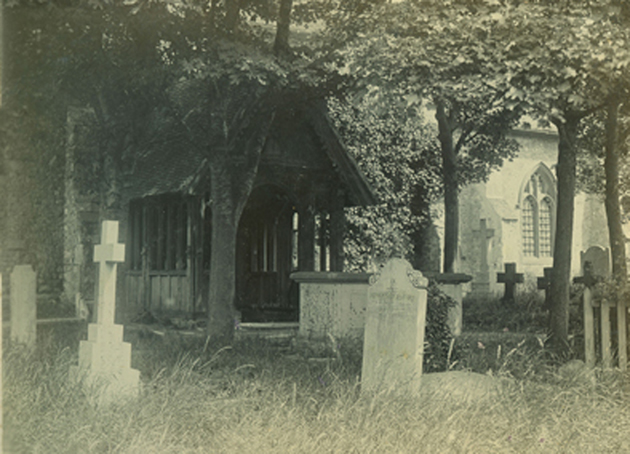
The Susannah Howard Stone in Benfleet Churchyard as pictured in 1895.
One help in looking into past lives is the ten-yearly Census. In 1841 a 26-year-old George Howard, a ‘Hoyman’, lived with his wife Susannah and a two-year-old son George at 36 South Street, South Benfleet. (South Street was the alleyway that runs from opposite the churchyard past the back of the Conservative Club.) As was common in those days, they also had a lodger, 75-year-old Diana Freeman. George senior’s place of birth is later given as Hullbridge/Hockley.
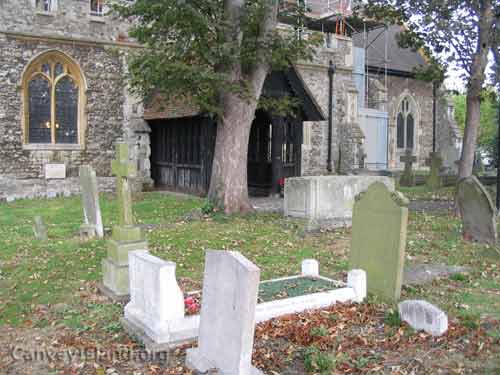
2008: The same scene many years on
It’s puzzling, but no record has so far been found for the Howards in 1851. We find the couple again in the 1861 Census, when the 48-year-old ‘Barge Master’ George Howard and his 40-year-old wife Susannah lived at No. 36 Rainham Street, Southwark, London.
Ten years later they lived at the address given on the stone: 17 East Lane, Bermondsey, London. George is registered as ‘Lighterman’ and they are wealthy enough to have a servant, the 15 or 16-year-old Esther Mason. Susannah’s job description is ‘Lighterman’s wife’, so it is quite possible she accompanied her husband as mate or assistant on the waters of southeast Essex. The picture shows East Lane, Bermondsey in 1890. It ran from Neckinger Road to the River Thames at East Lane Stairs. (As the style of houses suggests, it was an ancient thoroughfare and many of its properties date from before 1750. This view looks south along the west side of the street.) East Lane still exists in a truncated form. A school lies across it today, cutting it short, though an 1885 map shows it running down to the river, to East Lane Stairs, a pick-up point for passengers by watermen, the floating equivalent of taxis.
The Benfleet stone gives Susannah Howard’s death as 29 October 1871. We cannot be certain, of course, but given her husband’s profession and modes of transport, it would be most likely that Susannah returned on a hoy to her final resting place within sight of the Creek at the village of her birth. Her London address would have been a status symbol and a message to impress fellow villagers?
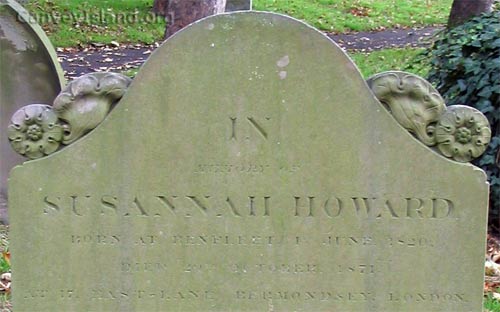
Susannah Howards Tomb Stone in 2008
At the 1881 Census George Howard, ‘Barge Master’ age 68, had a new wife, 53-year-old Emma, who was born in Milton in Kent in 1828. They still lived at the Bermondsey address. Equally ten years on, it still is the home of the now ‘Retired Lighterman’ and his wife Emma.
By 1901 George had died and the 73-year-old widow Emma (the Census makes her younger at 69) lives as a ‘lodger’ in an almshouse in Penge called Waterman’s Asylum. It’s not as bad as it sounds. A retirement home designed by George Porter, it was built as 48 dwellings in 1840. A booklet dated 1899 describes the establishment as ‘Royal Asylum for Poor, Aged, Decayed and Maimed Freemen of the Company of Watermen and Lightermen of the River Thames and their Wives or Widows, Penge, Surrey. It was converted to private homes in 1973.
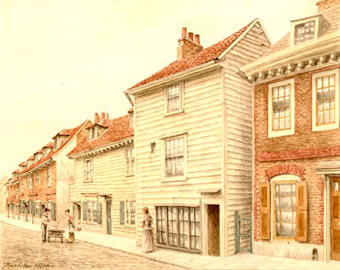
East Lane, Bermondsey, in 1890.
THE SECOND GENERATION
George and Susannah’s son George was missing from the Census of 1851 together with his parents. An answer might be that the family was out at sea, or even abroad on the night of the count. Ten years later, the couple are again on their own. We have, however found a George Howard who was born in Benfleet in 1939. Dates and associations fit and George Howard junior seems to have been a capable mariner. At 22 (in 1861) he was independent, a master mariner aboard a vessel called ‘The Flower of Kent’ with his ‘mate’ Robert Morely, aged 20, from Stanford le Hope. Very likely this was a Thames barge, possibly even a family barge.
By 1871 George Howard jun. was a Lighterman with a wife, 25-year-old Ann from Horsley Down in Suffolk, living at Wakering Street (or Road), Great Wakering. They’d probably lived with his parents at first, for their first son, five-year-old George, was born in Bermondsey. Three-year-old Susannah – no doubt named after her grandmother from South Benfleet – and one-year-old Henry M. were born at Great Wakering. There was also a fourteen-year-old Elizabeth Mansfield from Bermondsey, a servant and nursemaid.
THE THIRD GENERATION
Ten years later, when Susannah was 14 and Henry M. was 11, they lived at ‘Church Villa’, Wakering and had added another six children to the family, Annie (9), Charles (7), Emma (6), Arthur (4), Frank (2) and ten months old Ethel. Their father was a ‘Barge Owner’ now. George and Ann’s first-born is missing from the list, but at 15 he would have been old enough to earn a living and a George Howard can be found on a vessel called the ‘George & Susannah’ as a cook. The name of the vessel on which he served suggests the likelihood it belonged to his father or grandfather?
Alas, at the 1891 Census we find Ann Howard, a widow at 45, living in Wakering ‘New Town’, occupation: ‘Depending on sons for living’. With her were eleven-year-old Ethel and the last of her eleven children, seven-year-old Wilfred. Nine-year-old Margaret was not at home, but staying with her aunt and uncle Maynard in Rotherhythe. Of the sons on whom Ann depended, George, the eldest at 25, appears on the crew list of the Royal Navy as a Royal Marine aboard the vessel ‘Britannia’, moored in Dartmouth Harbour.
As seems likely, Maynard was Ann Howard’s maiden name. In 1851 a Maynard family, John, a Lighterman (with two barges) and Deputy Corn Meter* and Ann, his wife, 32 and 26 respectively and both born in Lambeth, lived at 3 George Place, Bermondsey. They had two daughters, three-year old Emma and five-year-old Ann, which would make Ann’s birth year 1846.
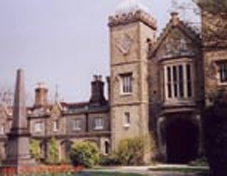
Waterman’s Asylum, Penge. Emma lived at no. 38.
(*A ‘Corn Meter’ was a man who was responsible for weighing out corn in the market place. Sometimes Lightermen, if they were carrying corn as a cargo, were also responsible for its distribution at its destination.)
If the Maynards only had two daughters, it would seem like good forward planning of their daughter Ann and her husband George’s part to give the second son – who was likely destined to take over the Maynard family business – ‘Maynard’ as his middle name. We can’t find the Maynards in 1861, so the possibility of more children must exist. Henry ‘M.’ Howard was born 1870. Alas, every good tale has its twist. The 1871 survey shows the head of the Maynard household is John aged 52, but he has a new wife, Eleanor, and two – new? – sons recorded as Charles aged 17 and George aged 6. George still was a scholar, but Charles is listed as a ‘boat builder’s apprentice’.
In 1891, Ann Howard’s second eldest son, Henry ‘Maynard’ Howard is ’22’ and staying with his uncle John Maynard and his family in Rotherhithe, as was his sister Margaret. Henry M. is described as an ‘apprentice Lighterman’.
Two other sons of George and Ann Howard, Charles and Frank, both were aboard a vessel named ‘Pride’ with Charles as mate and Frank at only 12 years of age a third class hand in 1891. A lighterman, as different from a waterman, was licensed by the Port of London Authority to carry goods, wares or merchandise without passengers. Watermen have been likened to taxi drivers, while lightermen drove the juggernauts.
One might call it a Benfleet dynasty of hoymen, bargemen, watermen and lightermen, but barges were beginning to lose out to the railways. Of George and Susannah Howard’s eleven grandchildren in 1901, George, the eldest, was still in the Royal Navy aboard ‘Hussar’, aged 36 and single like all his brothers. Henry Maynard Howard was ‘Lighterman & Waterman (Barge)’ and appears to be living with his sister Susannah and her husband in Gravesend. 28-year-old Charles was Captain of the barge ‘George & Ellen’, a Rochester sailing barge in Conyer Creek, Kent. Mate was Aubrey Wilson. Arthur was a dock labourer at Rotherhithe and Frank was mate on the ‘Zinita’ in Lowestoft harbour.
Annie Howard married George H. S. Murrell, a butcher in Prittlewell, Southend-on-Sea. In 1901 Ann Howard, now 55, was no longer living on money from her sons but had moved in with her daughter and husband at 46 Pleasant Road in the parish of St John, Prittlewell. Ethel Howard, born 1880, was a general domestic servant to a 64-year-old mercantile clerk, a widower, with a 16-year-old granddaughter. (Research thanks to Karen Bowman)
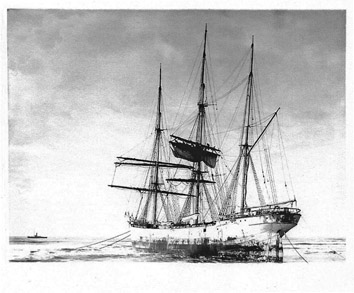
We have not found a picture of the barge Zinita, but the British barque ZINITA is pictured here stranded on Copalis Beach in 1896.
OF BARQUES OR BARGES?
There has been an interesting follow-up to the Howard saga. A Canadian who is transcribing his grandfather’s diary recording five years sailing the world’s oceans on a barque called the Zinita, got in touch, enquiring about the Zinita young Frank Howard served on in 1901. The Canadian ‘s grandfather’s diary recalls some interesting times before the mast (1905-1910).
A ‘Zinita’ made the news in 1905 when the 1525 ton barque collided with and sank the iron barque ‘Coimbatore’ 200 nautical miles off Cape Leeuwin, Western Australia on the 25th December that year. Her bowsprit and gear were carried away, but she reached port safely. Christmas Day would seem an auspicious date for such an accident out on the open ocean. There was just one survivor from the Norwegian ship, one man had fallen or jumped on to the Zinita’s deck at the moment of impact, all others were lost that night.
Alas, a Thames barge called ‘Zinita’ was built at Deptford in 1899 and registered in the Port of London. She was owned by Messrs. E. J. & W. Goldsmith, a firm of barge owners founded in 1848. They owned the Wharf at Grays, which in the early years of the 20th century was the home port for 140 vessels, the largest fleet of barges ever recorded. Our Frank Howard with his barge family background seems more likely to have sailed home waters than the open ocean, though crew lists of either vessel have yet to be found.
The barque Zinita was renamed Sorknes in 1910 and was broken up as a hulk in Dartmouth Harbour in the early 1950’s. The Canadian’s grandfather ended up captaining Union Castle Liners.


Comments about this page
I am from a long line of watermen / lightermen. I have the list of bindings from 1692. I have been intrigued by the connection between my family and the Howards. There is the christian name of Briton in my family and Briton Michael Howard apprenticed my great grandfather although there were other watermen / lightermen in his family. An 1881 census shows a Bullock lighterman (connected) living on Canvey.
Elizabeth Howard had to be a widow or husband away (was she the nursemaid?) apprenticed Robert Galvie Howard of Bermondsey 9.7.1806 who was subsequently drowned at sea. The lady lodger Diana freeman was she related? because in 1850 George Freeman of Bankside apprenticed a boy William Henry Howard. John Maynard of Deptford apprenticed Henry Maynard Howard 9.7.1889. Another widow or as above Mary Ann Howard Sth Benfleet apprenticed Daniel White Howard 9.2.1854 Does this help or confuse?
Before registering I made, hopefully helpful comments, were they erased when submitting?
Hi Barry
All your comments are here although I haven’t published the first one yet as it is labelled ‘personal’ – I’ll publish it if requested.
Thanks for this excellent information – I shall ensure the researcher Robert Hallmann is informed about these updates!
I ommitted that George Freeman (b) 1829 above of Bankside was born in Benfleet. He was apprenticed by George Howard in 1836. The Howard name along with Maynard, Bullock and Freeman from pre’ 1692 are family names still working as Watermen/Lightermen on the River Thames. My novice researching is showing are marriage connected thro’ the generations.
I am sorry I forgot to add the mention of George in the 2nd generation born in Bermondsey. Horsleydown are stairs in Bermondsey where apprentices when bound put as their living area and intended place of work. Coincidence that Ann is stated as born there?
Hello, I have read this page with interest. I am currently researching my Mothers Family and have found out that we are connected to the Howards of Gt. Wakering and area through Israel Howard (1789) and his daughter Mahala(1817). Mahala married a Thomas Fagg. I would be very interested in any stories relating to the family, which I know originated on the other side of the river at Greenhithe. Thanks Mandy Heath
I am related to Robert Walker Morley 1841 -1879 who was mate you referred to on the Flower of Kent. Fascinated to find the connection on this website.
I have found this article very interesting as I am a great great grand daughter of George and Suzannah.I have read several articles in various books about the Howards and I am now embarking on a search to find out how far back the Thames barge connection goes.
I would love to able to get in touch with Barry Bullock who commented earlier. His reference to Briton Michael Howard caught me eye. Briton is my husband’s 2nd. Great Grand Uncle. I have only just started trying to track him as the family bible had his name as Barton Michael Howard. His parents are William Howard & Sarah Ann Grace. William was also a master mariner or lighterman.
I am related to the Howards of Wakering and several relatives born in Graet Wakering skippered Thames Barges including the Edith May and the Gladys. I noted that Jane Venner had read several articles in various books about the Howards. Is it possible to share any references as I am struggling for information.
In answer to the article written by Elaine Roberson.I can not remember some of the books at present but might be able to get back to you on that as my brother will almost certainly remember.However,’Spritsail barges of Thames and Medway’ by Edgar March certainly contains a lot of information on the Howards of Wakering.You will almost certainly have to order from the library.Would be interested to know who your ancestors include as we could or almost certainly related.
Very interesting article. I am just learning a bout the lightermen and watermen of the Thames. similar to Barry bullock and Lyn I am related to William Howard (father of Briton Howard(, he was my great great grandfather. Further research is in order – thanks for the leads
Fabulous insight of the Howard family and Great Wakering I believe my g g grandfather may have been part of this family first found him in 1861 as a lighterman in lambeth however later a barge master of the ‘Belsey’ cannot find any records of this barge on bargemaster website a little more research is in order I think Jen
I have followed up the lead from Lyn, regarding William Howard and Sarah Ann Grace. Both families were very active ‘River’ people of Rotherhithe with Watermen/Lightermen and Mariners. Their sons were Briton Michael Howard (1835) and my great grandfather William John Howard (1828) who was educated as a Law Writer. He ended up in Manchester where my grandfather John Howard was born in 1866. This information helped me in a ten year search to find John Howard, as a result I have just returned from Australia where I met several cousins and was given my first photo of my grandfather. So thanks Canvey Island site for your help. I am now further uncovering the Howard, Grace families of ‘River Folk’.
Any help is welcome! – Pete
William Howard waterman/lighterman and mariner apprenticed 1820. Following a little River work he went to sea and his first of seven ships was the ‘Briton’ which transported convicts to Australia, his last ship was the ‘Louisa’ in 1846, he is recorded as ‘Died at Sea’ and young Briton was listed that; by the Disrict of St James Bermondsey ’is a proper subject for the Charity’
Briton Michal Howard obviously named after his Father’s first ship, was apprenticed in 1850 and later married Matilda Bullock my gt gt grandfather’s sister, Edward Pring also a W/L married her sister Elizabeth, both families named boys Briton, my family has a two week old Brit as our most recent.
I worked with see Eddie Pring in the 60’s and still see him and through this latest research, we have the same gt gt grandfather.
Buzz B
A question for Peter. Peter have you come across the name Tozer a Gravesend family in your research, because William Howard from previous mail was apprenticed by Alexander Tozer 21,7,1820, Briton Michael Howard was apprenticed by Richard John Tozer 9,5,1850. My gt grandfather whose father had died was apprenticed by Alexander Tozer in 1896.
I only came across one lighterman named Tozer in 50 years, he was unforgettable, I was a tug boy in 1965 and 3 years into my apprenticeship. The tug towed him/barge up into Dartford Creek, the way he talked and looked I had and never have seen anything like him, there was his accent his dress, a real character in the true sense of the word.
Hi Barry,
Yes I have come across the involvement of the Tozer families and their connection to William Howard and their son Briton. There are quite a few marriages to Howards and Grace families, another Wide Thames family. Thanks for the tip that my great great grandfather died at sea, no wonder I couldn’t find a death record! Quite a journey for me finding all this from the entries on this site, thanks Canvey Island site!
There appears to be so much interest in the Howard waterman and lighterman. There are so many in the records too many to add, but I will when I have an afternoon to spare. I have gone through the Doggetts Coat and Badge race records back to 1715.
Edward Mills Howard (Cupid’s Bridge Lambeth) bound by Elinor Robinson 26.8.1715 (1715 was the 1st race rowed) winner in 1723.
Thomas Mills Howard (Irongate) bound by William Pickering 9.3. 1843. 5th in 1850
Thomas Richard Howard (Rotherithe) bound by William Christian Callow 10.5 1864 entered. Failed in the lots 1869.
James Howard (Horsleydown) bound by John Benson Martin 10.1. 1850 entered. Failed in the lots 1857.
Edward Henry Howard (Richmond) bound by Edward William Howard 13,7. 1886. 4th 1893.
Nicholas David Howard due to the decline of apprentices to compete in the race it was decided 1971-3 that boys would be allowed to compete in 3 consecutive years (Gravesend) bound by David Howard 1991. 3rd 1997, 4th 1998, hot favourite in 1999 4th.
Only six boys could compete for the Coat and Badge, if more than six entered the process of drawing lots took place, nowadays heats are rowed over a two mile course Putney to Hammersmith.
Incidentally in my year 1967 11 boys entered, I being one, after the elimination of five boys, I came 4th.
Jane Venner recommended the book ‘Spritsail Barges of the Thames and Medway’ on an earlier comment, I ordered it from the library and will be returning it tomorrow if anyone is waiting for it, because I think it came from another library.
The chapter on the Thames has tale of a Howard murder and smuggling.
For Jane: William Peter Venner was a waterman/lighterman from Bermondsey 1829, he died before he gained his Freedom. William’s Father, William Wood Venner and Master was also a w/l 1800 from Horselydown Bermondsey.
I have recently found buried in my files a site ‘The Vandervord Family’ their site has information of sailing barges, skippers and owners along with various links for researchers.
When my great grandparents Ada Higgins and Edward Daniel Howard-Wisby married in 1900 they were both descended from sailing families – Ada Higgins grandfather was Barholomew Higgins who was a master mariner who spent a lifetime at sea, mainly on steam screw ships, while Edward Howard-Wisby’s ancestors were the Howards of Great Wakering/Barling and the Wisbys from Foulness. I only found out about the Howard’s connection to Thames barges very recently and I am currently researching into that branch of the family.
Hi there, thank you so much for writing this. I have just discovered that Susannah and George are my 4th great grandparents, my great great grandfather is George Murrell. I found Susannah’s grave today. I grew up in Shropshire but knew my Nan was from Southend and I now live in Benfleet. It’s truly amazing. Any other info please let me know.
Thank you for this very interesting page. I was initially excited when I read the name George Howard as my Great-great-great grandfather was George Howard, Hoyman, South Benfleet married to Mary Ann and connected to me through son Israel. I believe George’s father was William. Susannah is not directly a relation it seems but perhaps a connection exists further up the tree.
There was a George? Howard from Wakering, on his first trip to London skippering a sailing barge on arrival moored near Westminster, while walking along the Embankment alone after midnight was confronted and had his throat cut and was robbed.
His father the owner of the barge was so distraught that he sold the business. The assailant was caught but I cannot remember his name or sentence. I found that info’ several years ago on the ”Old Bailey Archives”
Hi, I am researching my family history. Can somebody please tell me if the Howard’s in this article are related to Sidney Howard, author of the book ‘Thames to Tahiti’?
Sidney Howard is my great uncle, his brother William
was my Grandfather.
Add a comment about this page